
Best practices for at-risk skin at the end-of-life or in palliative or hospice care

People at the end-of-life, or those receiving palliative or hospice care, constitute a group at extremely high risk for skin issues.1 Recognizing and proactively addressing at-risk skin in this population is central to comfort, dignity, and quality of life.
Common skin and wound problems at the end-of-life
- Bruises
- Rashes
- Skin tears
- Incontinence-Associated Dermatitis (IAD) or Moisture-Associated Skin Damage (MASD)
- Malignant wounds and fungating wounds
- Pressure injuries
- Skin Changes At Life's End (SCALE)2
- Skin failure: acute, chronic, and end-stage
Educate patients, families, and caregivers
Patients, residents, family members, and caregivers should be educated about at-risk skin in this population and about the early signs of skin problems.2 Educational sessions should be documented, evaluated (for example, demonstration and return-demonstration), and reinforced over time.
Care plan proactively for at-risk skin
Care plans for patients or residents at the end-of-life, or receiving palliative or hospice care, should proactively address at-risk skin.3 The following nursing diagnoses can be care-planned when applicable to an individual:
- Risk for alterations in skin integrity
- Risk for alterations in tissue integrity
- Risk for skin failure
- Risk for Incontinence-Associated Dermatitis (IAD) or Moisture-Associated Skin Damage (MASD)
The goal of care is to promote comfort and dignity, to relieve suffering, and to improve the quality of life for patients, families, and caregivers.
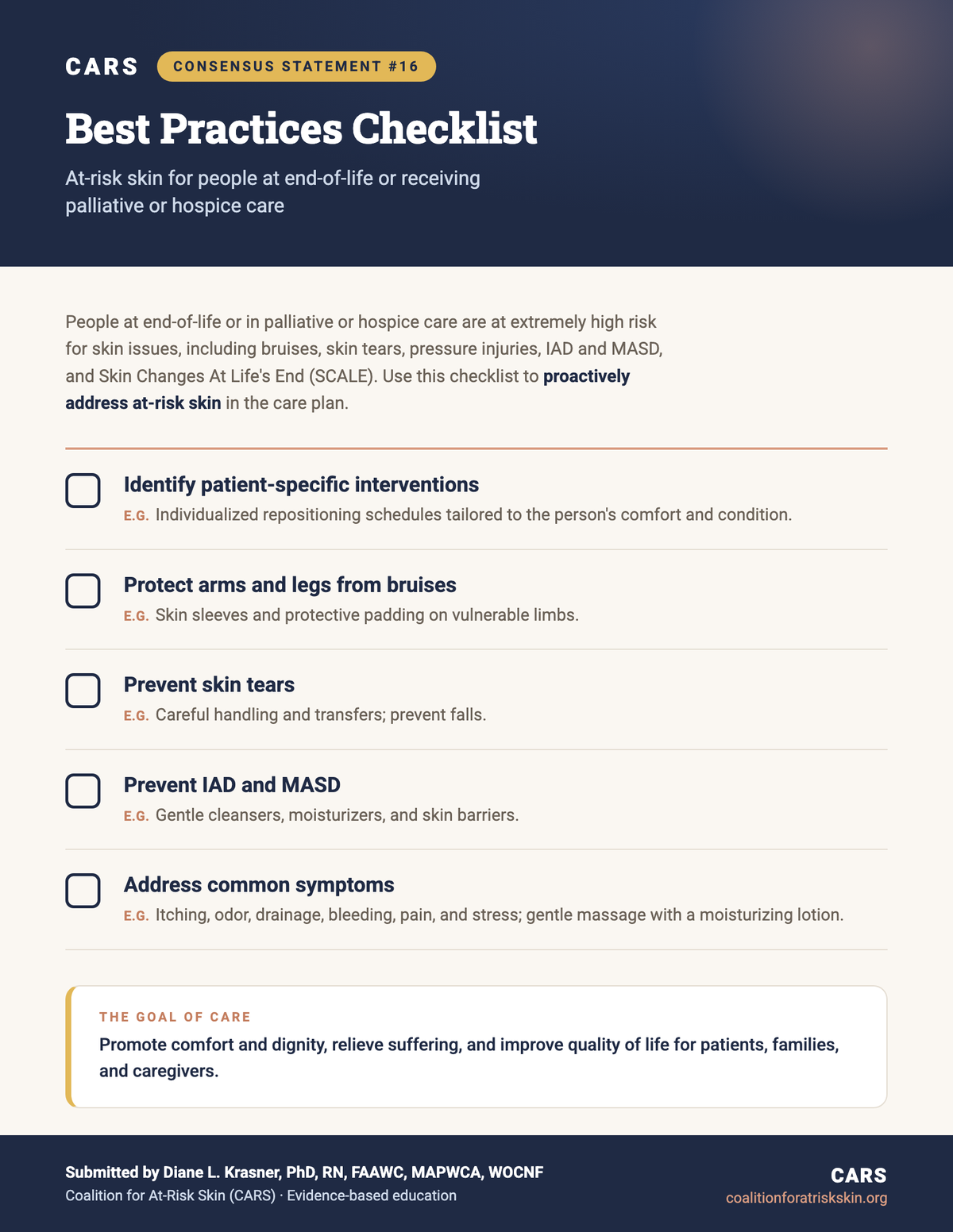
Best Practices Checklist
A one-page, printable checklist for addressing at-risk skin at the end-of-life or in palliative or hospice care. Sign up free to download it, the same way you access every resource in the CARS library.
Sign up to downloadSign up to download
Free for patients, caregivers, and clinicians. Sign up once to unlock the checklist and the full CARS resource library.
References
- Woo KY, Krasner DL, Kennedy B, et al. Palliative wound care management strategies for palliative patients and their circles of care. Adv Skin Wound Care 2015; 28:130-140.
- Krasner DL. SCALE, Skin Changes at Life's End: A Guide for Patients, Families and Caregivers. WoundSource 2021.
- Gethin G, Kottner J, Lamza A, et al. Palliative wound care: recommendations for the management of wound-related symptoms. J Wound Management 2025; 26(1 Sup 1): S1-S40.
Explore the full CARS resource library
Printable infographics, clinician tip sheets, and patient education across all seven categories of the CARS Consensus Statements. All free.
Explore Free Resources
Diane L. Krasner
Dr. Krasner is a wound and skin care consultant and a CARS board member with more than three decades of clinical and academic expertise in wound, ostomy, and continence care. She is a member of the CARS expert panel behind the 21 evidence-based Consensus Statements on at-risk skin.